
This website uses cookies to improve your experience. We'll assume you're ok with this, but you can opt-out if you wish.
Riding arena construction
You’ve put in the work, checked your gear, and felt the energy of the crowd. Excitement fills the air as your heart beats a little faster. You swing into the saddle and exhale as you round the corner….Riding
The only sounds are pounding hooves and breathing. It’s just you and your horse—the crowd fades away. Nothing exists but this moment. You round the final turn, and suddenly the stands come alive again….
And that was just morning tea on the deck….
Let us be part of your journey.
We would love to come to your site and discuss your dreams.
What Size Should an Arena Be?
Dressage Arena Dimensions:
- Small: 20 m x 20 m (65.6 ft x 65.6 ft) – Ideal for training sessions and smaller competitions.
- Standard: 20 m x 60 m (65.6 ft x 196.9 ft) – Commonly used for most competition levels, including international events.
- Large: 20 m x 80 m (65.6 ft x 262.5 ft) – Occasionally utilized for specialized training and events.
Hunter/Jumper Arenas:
- Small: 20 m x 40 m (65.6 ft x 131.2 ft) – Suitable for warm-ups or training smaller horses.
- Standard: 50 m x 80 m (164 ft x 262.5 ft) – Typically used for various competitions, including the Olympics.
- Large: 60 m x 100 m (196.9 ft x 328.1 ft) – Ideal for large competitions and courses with extended galloping stretches.
Barrel Racing:
- Small: 100 ft x 100 ft – Used for training or smaller-scale events.
- Standard: 150 ft x 200 ft – The most common dimension for competitive barrel racing.
- Large: 180 ft x 250 ft – Suited for larger competitions and professional-level events.
Reining:
- Standard: 100 ft x 200 ft – Common in competition and national events.
- Large: 150 ft x 300 ft – Used for international events and advanced reining activities.
Where to Build a Riding Arena
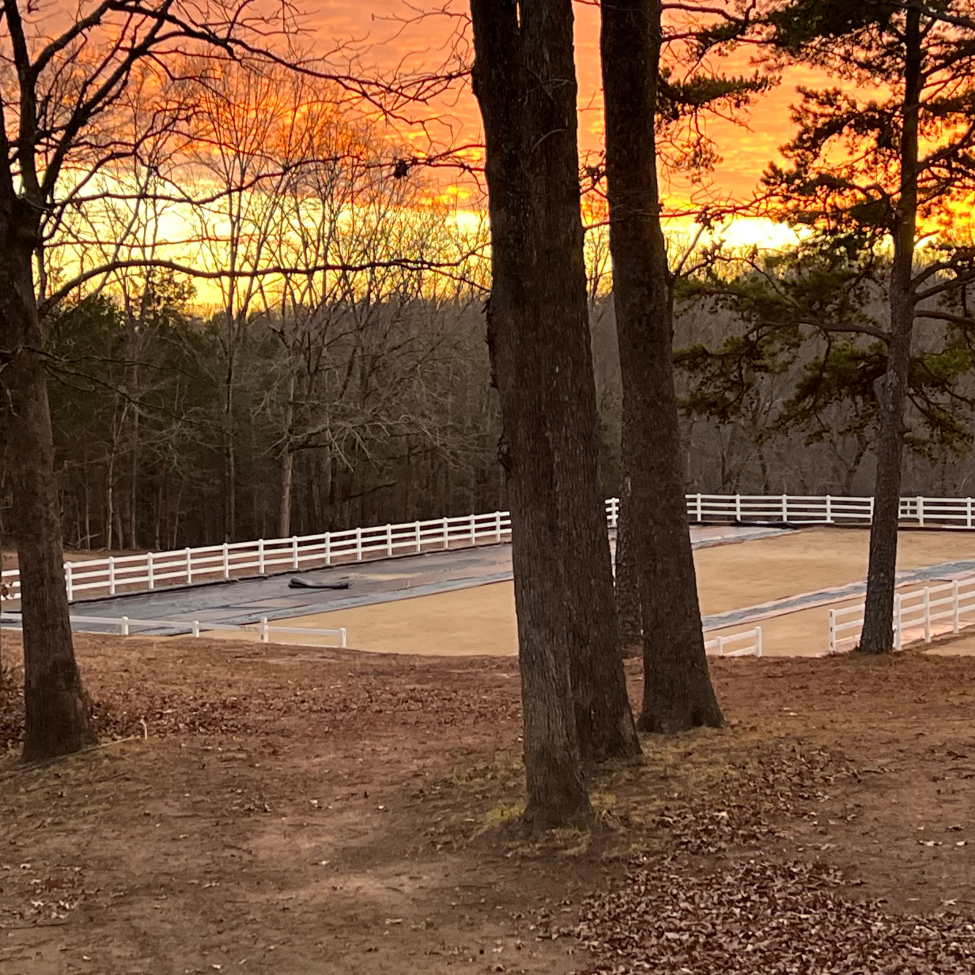
Once you’ve chosen a size for your arena, you’re ready to pick a location. You’ll need to find an area that offers the amount of space you’re looking for. If you own stables, keep in mind how far your arena is from your horse.
Finding a location that needs less leveling and excavation will help you to keep costs down. You’ll also want to consider the potential for flooding. For outdoor arenas, an area that has a lot of sun exposure can help dry your arena after rainfall.
You will want an area far enough from tree lines to keep leaves from falling into the arena.
Arena Drainage
Proper drainage is a crucial step in building a riding arena. Effective drainage systems will help maintain the quality of your arena. Drainage issues can cause poor performance and increase wear on your arena, which can create additional costs and maintenance later on.
French Drains:
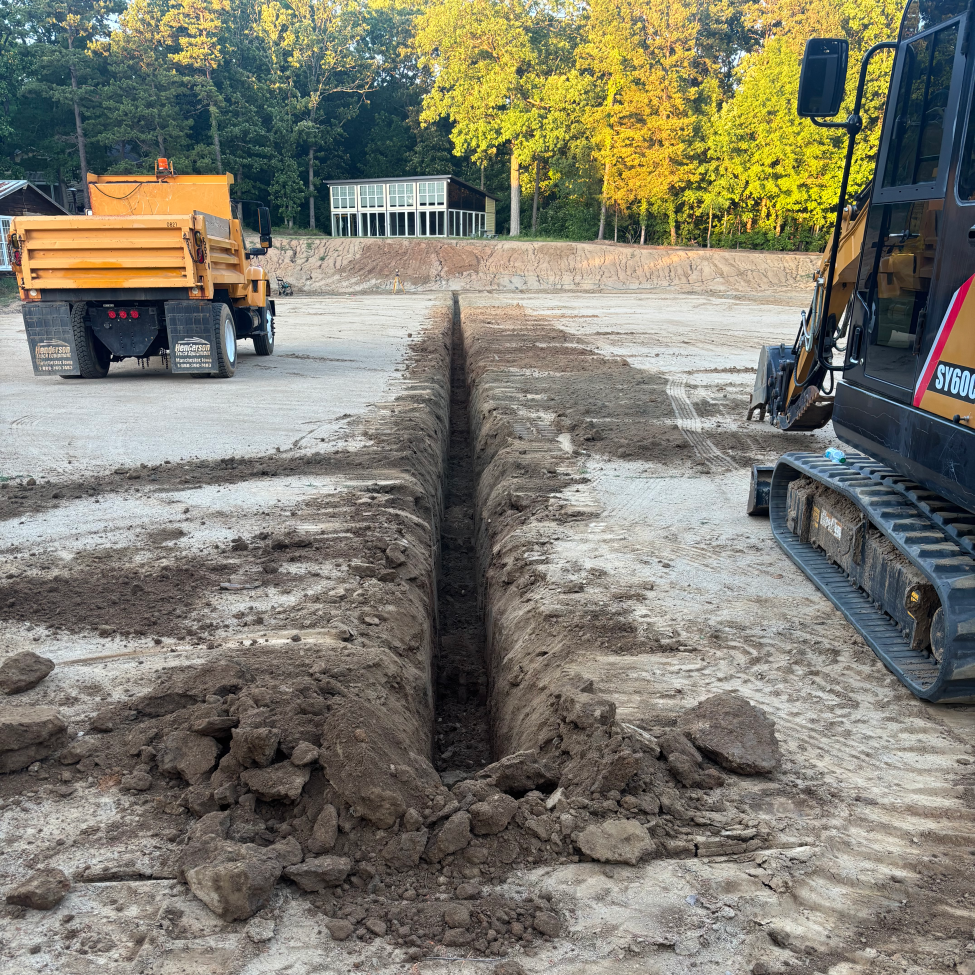
French drains are one of the most common drain types used for outdoor arenas. They are comprised of trenches containing drainage pipes that allow water to flow outside your arena.
Engineered products:
There are a lot of products available to use in place of or in conjunction with french drains. Depending on your site we can discuss the best options.
Arena Base
Both indoor and outdoor bases should provide suitable stability, traction, and shock absorption. However outdoor bases should also remain considerate of drainage solutions. Outdoor arena bases need to be permeable to prevent flooding from rainfall and runoff, and drain quickly in order to allow you to ride sooner.
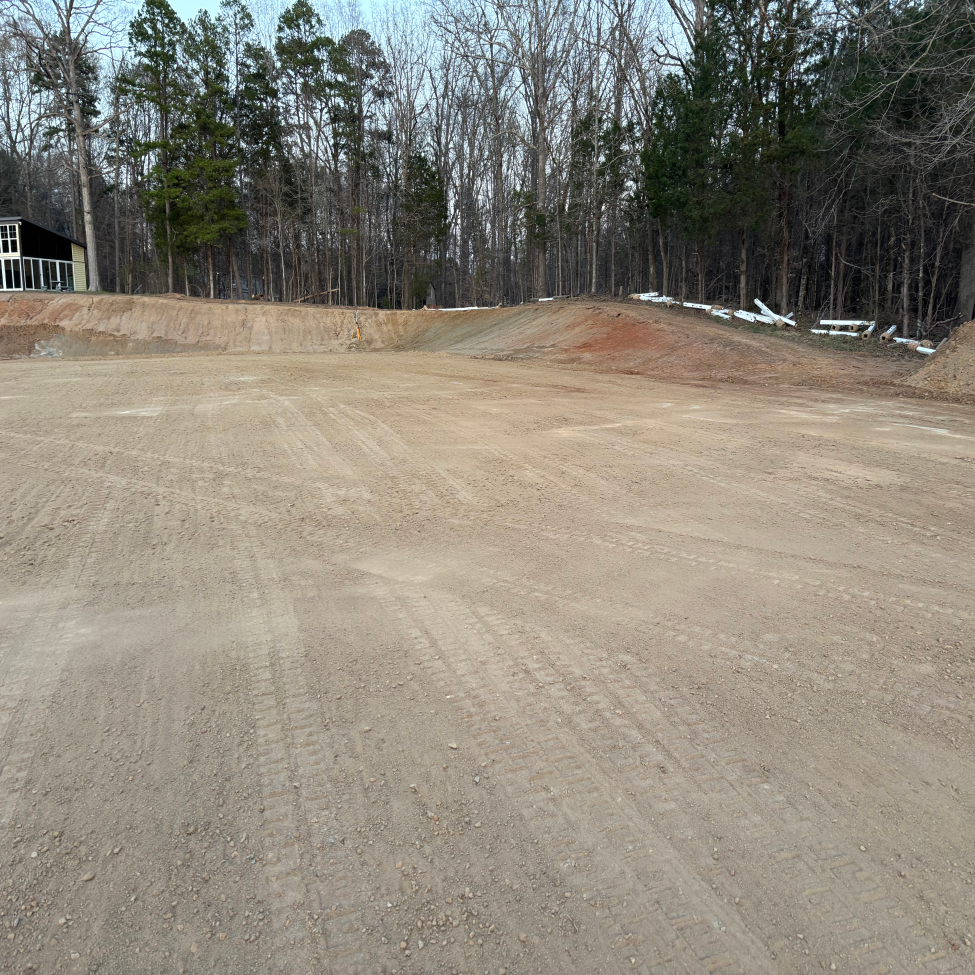
Riding arena bases are usually comprised of 4-6 inches of compacted, well-graded materials. The base material, such as crushed stones, is introduced and compacted. The base needs to be thoroughly compressed to prevent any uneven surfaces.
FYI… to put 6″ of gravel on an arena that is 100′ x 200′ will take 525 tons of material.
Riding surface
Sand:
Finding the right footing is necessary to achieve the highest performance level and to create a healthier and safer riding environment for you and your horse. To achieve the best ride, there is no one-size fits all footing option. Consider what you intend to use your arena for and what local materials are available.
Additives:
Footing additive blend with your arena sand to soften horses’ impact, reduce compaction and stabilize the footing. It also helps prevent small sand particles from releasing into the air as dust. Footing additives are important to create additional cushioning and reduce dust, improving your ride and the safety of you and your horses.
Dust:
Having too much dust when you ride in your arena not only decreases performance, it can be a health hazard for both the rider and the horse. If you’re concerned about dust in your arena, consider adding a dust reduction solution to your arena footing. A watering system may also be needed.
Fencing/Border:
Indoor arenas are enclosed, fencing is only needed if you’re building an outdoor arena. Fences around the sides of the arena can be made of wood but, if you’re looking for a sturdier option, you can find fences made from steel and other metals.
All arenas are recommended to have a border in place, to hold in the footing and sand. These can be as simple as using railroad ties or pressure treated wood options.
Maintenance
- Keep sand particles and footing products mixed
- Loosen a compact surface
- Tighten a loose surface
- Level out the surface – divots, deep/shallow spots, hard spots, etc.
- Eliminate ruts in high traffic areas
- Pull in migrating materials
- Minimize dust and promote drainage
Laser Grading
During new construction our company uses top of the line equipment to achieve a surface that is flat and on grade. Each layer is laser graded then compacted. You will need to dress the sand layer to maintain the integrity of the surface. Over time your surface will shift and the sand will need to be set back to flat and on grade.
We will come laser grade your older arena and get it back to new condition.
Riding Riding Riding Riding Riding Riding Riding Riding Riding Riding Riding Riding Riding Riding Riding Riding
